
Environment
TBM has established the TBM Environmental Policy to encourage all members working on a variety of businesses at multiple locations to come together and promote environmental awareness.
- Environmental Management
-
Life Cycle Assessment:
Reduction of product's environmental impacts -
Resources
& Circular Economy - Climate Change
-
Biodiversity
& Ecosystem Services
Environmental Management
TBM has established an environmental policy to encourage all members working on a variety of businesses at multiple locations to come together and promote environmental awareness.
TBM Environmental Policy
In order to pass on a sustainable society and rich natural environment to future generations, TBM will continue to strive to achieve net zero environmental impact in its value chain and to solve environmental and social issues through its business. This policy was established following a resolution by the Board of Directors on January 14, 2022.
For more information about TBM's environmental policy, click here
In accordance with this environmental policy, we have established an environmental management system and are promoting systematic efforts to improve our environmental performance based on the PDCA cycle, with the aim of further increasing the positive impact we have on the environment through our business.
This environmental management system has been verified by a certification body that we meet the requirements of the international standard ISO 14001 set by the International Organization for Standardization (ISO) at four locations, including our own production sites (Tokyo Head Office, Technology Center, Tohoku LIMEX Factory, and Yokosuka Circular Factory).
- Certification Details
- ・Certified organization:TBM Co., Ltd.
- ・Applied standard: Environmental Management System ISO 14001:2015
- ・Certification registered date: April 19th, 2024
- ・Scope of registration: The manufacture of inorganic-organic composites, recycling of plastics and inorganic-organic composites, and sales of plastic scraps and recycled plastics
- ・Certification body:BSI Group Japan K,K.
- ・Certification number: EMS 803494
- ・ Certification registration certificate
Life Cycle Assessment: Reduction of product's environmental impacts
We use Life Cycle Assessment (LCA), which is a scientific method for quantitatively evaluating the environmental impact of the entire product/service life cycle or its specific stages. This is to comprehensively understand and reduce not only the environmental impact caused by TBM, but also the environmental impact caused upstream and downstream of the supply chain.
Our assessment started jointly with the Oki Laboratory of the Institute of Industrial Science, the University of Tokyo in 2016. From 2018 to 2019, we conducted the LCA on LIMEX Sheet and products made of LIMEX Pellet with Japan Environmental Management Association for Industry (JEMAI). From 2020, we are working on LCA with the cooperation of the Sustainable Management Promotion Organization (SuMPO), which took over the business of JEMAI's industry support department.
At the development and manufacturing stages, we use this LCA method to quantify the environmental impact at each stage of the product life cycle, identify the characteristics of the environmental impact for each product, identify areas for improvement, and confirm the effects of improvements. .
Resources & Circular Economy
Reducing dependency on unevenly distributed resources
TBM develops, manufactures, and sells LIMEX mainly made from limestone, which is abundant throughout the world, thereby reducing the use of petroleum-based plastics, which utilizes oil that are mined only in limited areas of the globe. In addition, as it is said that 51% of the world's population will be at risk of high water risk by 2050 *, we provide LIMEX Sheet, which can be manufactured using less water.
*WWF 2020 “Water Risk Filter Brief”
Material Circulation
TBM promotes resource recycling to prevent environmental problems associated with resource usage, such as the depletion of natural resources and pollution from waste.
Specifically, we have been working on utilizing scrap materials generated at our own factories since the start of operations, and we can now reuse most of these materials as raw materials.
In addition, we are also engaged in the recycling of our used products and waste plastics through our business operations.
Climate Change
Target
TBM has set the following three Decarbonization targets, aligned with international standards, to realize a sustainable society.
- Eliminate GHG emissions (Scope 1 and Scope 2) from TBM
- Reduce GHG emissions (Scope 3) in the value chain by half compared to fiscal 2020 levels
- Contribute to reducing GHG emissions throughout society
TBM's targets have been certified as "1.5°C targets" by the Science Based Targets initiative (SBTi), an international initiative established to promote the achievement of GHG (greenhouse gas) emission reduction targets. Additionally, TBM has signed The Climate Pledge, a commitment to climate action launched jointly by Amazon and Global Optimism.
GHG emissions from TBM in 2024 (Scope 1 and Scope 2) were reduced by 73% compared to 2020. GHG emissions across the value chain (Scope 3) increased by 474% compared to 2020, due to factors such as increased production volume and expanded calculation scope. Furthermore, the GHG emission reduction contribution* associated with LIMEX product sales in 2024 amounted to 11,494 t-CO2eq.
*GHG Emission Reduction Contribution: Estimated total of LIMEX business and resource recycling business. Calculation methods may be subject to change in the future.
GHG Emissions Reductions
TBM uses electricity that is effectively "100% renewable energy-derived" and "CO₂ emission factor zero" at its Tohoku LIMEX Plant and Yokosuka Circular Plant. This significantly reduces energy-related greenhouse gases such as CO₂ associated with operations at both plants, contributing to the reduction of GHG emissions throughout the supply chain for the LIMEX Sheet and LIMEX Pellet products provided to our customers.
Calculation and Information Disclosure
TBM calculates Scope 1, Scope 2, and Scope 3 GHG emissions and discloses them in our sustainability report. We strive to collect information necessary for reduction by identifying not only our own direct emissions but also indirect emissions in the value chain. We also place importance on disclosing the collected information to stakeholders.
Calculation of CO₂ Emissions Associated with Transportation in Collaboration with Hakoberu Co., Ltd.
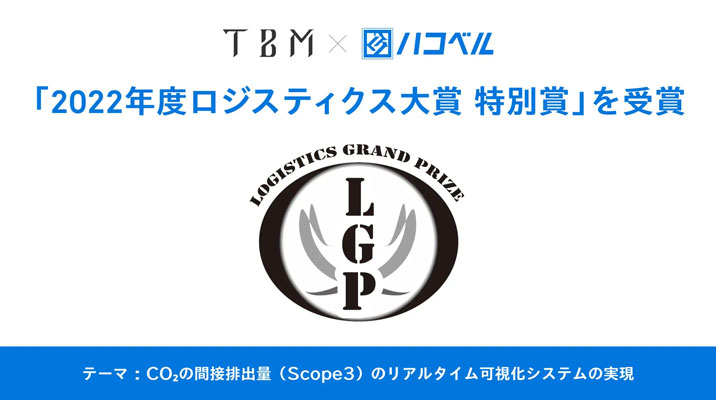
To enhance the accuracy of calculating CO₂ emissions associated with transportation by accumulating emissions on a per-project basis rather than relying on scenario-based estimates, we collaborated with Hakober Co., Ltd. to develop a system that visualizes CO₂ emissions without increasing operational burden. This initiative received the Special Award at the 2022 Logistics Grand Prize, hosted by the Japan Logistics Systems Association.
Hacobell and TBM won 2022 Logistics Grand Prize Special Award
Responses to CDP questionnaires
TBM has voluntarily responded to the questionnaire from CDP (formerly the Carbon Disclosure Project), an international ESG disclosure and assessment organization, since 2017. For fiscal year 2024, we received ratings of B for Climate Change and B for Water.
Support for calculation and reduction of GHG emissions
In response to the requests from our customers, TBM operates ScopeX, a platform that supports the calculation and reduction of GHG emissions.

Biodiversity & Ecosystem Services
Development of biodegradable LIMEX
Policies for addressing marine plastic pollution vary by country and region. For example, China, the world's largest consumer of plastic, *We are actively promoting the introduction of biodegradable plastics. Biodegradability refers to the property of decomposing into water and CO₂ through the action of microorganisms. TBM, in 2021, partnered with a major Korean conglomerate... Established a joint venture, "SK TBMGEOSTONE Co., Ltd," in collaboration with SKC, a major chemical materials company within the SK Group. We are promoting the development and commercialization of biodegradable LIMEX.
*OECD 2022“Global Plastics Outlook: Policy Scenarios to 2060”
Utilizing Marine Plastics
TBM is working to recycle the plastic litter that has washed ashore on the coast and aiming to reduce marine litter and create businesses. We participate in "Project Ikkaku, an industry-academia collaboration jointly implemented by the Nippon Foundation, the Japan Advanced Science and Technology Organization for Education, Human Development and Research (JASTO), and Leave a Nest Co., Ltd. As part of this, we made bags for collecting litter that has drifted ashore from marine plastics. We also support the recycling of oyster pipes by Scout Association of Japan's "Plastic Garbage Busters Daisakusen Upcycle Mission"
Marine Debris Collection Bags

When unfolded, it becomes a leisure sheet
Marine Debris Collection Bag
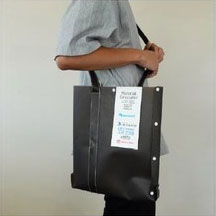
Small pouch for collection
of smaller plastic debris