
CCU Business

- CCU
About the business - Surrounding the business
Environment and challenges - Business content
- World Carbon
Pricing Trends - Contact
Turning CO₂ into a Resource for the Future
This project aims to resolve global environmental and social issues by converting CO₂ emissions, which are generated in large quantities around the world, into valuable resources and supplying them as environmentally friendly materials. Specifically, we partner with businesses with high CO₂ emissions (such as thermal power plants and steel mills)* to capture CO₂ emissions using carbon capture and utilization (CCU) technology and chemically react it with waste-derived calcium to produce calcium carbonate. This recycled CO₂ calcium carbonate can be used as a raw material for interior and exterior construction materials. Furthermore, when blended with recycled plastics, it can become an alternative to petroleum-based plastics and can be supplied for a variety of applications. Furthermore, we will create "environmental value" through the reduction and fixation of CO₂ generated by the business cycle in the form of carbon credits. This will enable businesses with high CO₂ emissions to reduce their emissions, and companies that use materials will be able to reduce their environmental impact in their supply chains and ensure stable procurement of low-carbon material. Through this scheme, we will meet two demands: solving the issue of CO₂ emissions and supplying sustainable materials, thereby contributing to achieving carbon neutrality for society as a whole.
*Among large facilities such as factories and power plants that are legally required to report their emissions, just the top 1 percent by emissions account for about half of all reported emissions. The top 100 facilities, most of which are thermal power plants or steelworks, alone account for around 26 percent of Japans total emissions, more than one quarter, showing that emissions are concentrated in a small number of large sources.
Source: Calculated based on the Ministry of the Environment publications “Greenhouse Gas Emissions and Removals in Japan for Fiscal Year 2022 (Final Figures)” and aggregated data from the “Greenhouse Gas Emissions Accounting, Reporting and Disclosure System.”
Source: Calculated based on the Ministry of the Environment's "Greenhouse Gas Emissions and Removals (Final Values) for 2022 (Reiwa 4)" and the results of the "Greenhouse Gas Emissions Calculation, Reporting, and Publication System."
Business Environment and Challenges
As the world moves toward carbon neutrality, companies are expected to reduce emissions across their entire supply chains and make ESG-conscious management decisions. This puts cost pressure and operational constraints on hard-to-abate sectors such as thermal power and steel, while simultaneously driving demand for low-carbon materials and emission reduction solutions. Globally, regulatory and market changes such as the EU Carbon Border Adjustment Mechanism (CBAM) and rising carbon prices are accelerating investment in plastic alternatives, turning decarbonization into a growth market. CCU, which converts CO₂ into a resource, is one of the key investment areas in the government’s GX strategy, and TBM is building a future economic standard that addresses both the challenges of GX emission sources and growing demand for low-carbon materials.
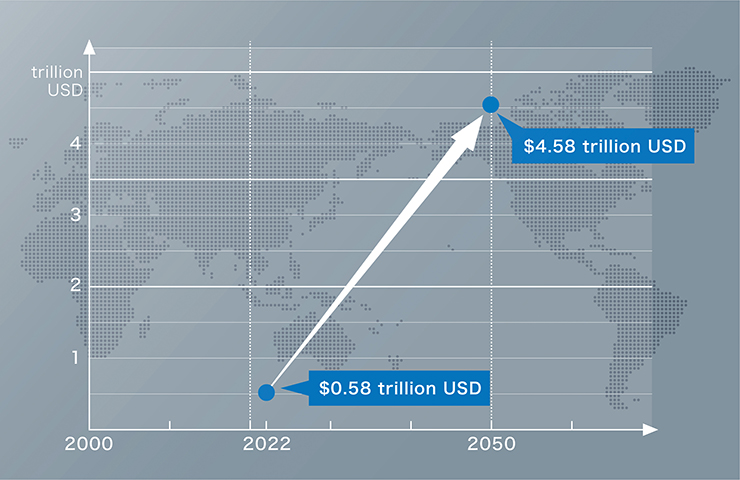
Massive Market Potential: CO₂ utilization products market growing to approximately 71 trillion yen
The market for products made using CCU technology from CO₂ is expected to expand rapidly worldwide. The global market for CO₂-utilizing products is expected to reach approximately 9 trillion yen in 2022 and 71 trillion yen in 2050.
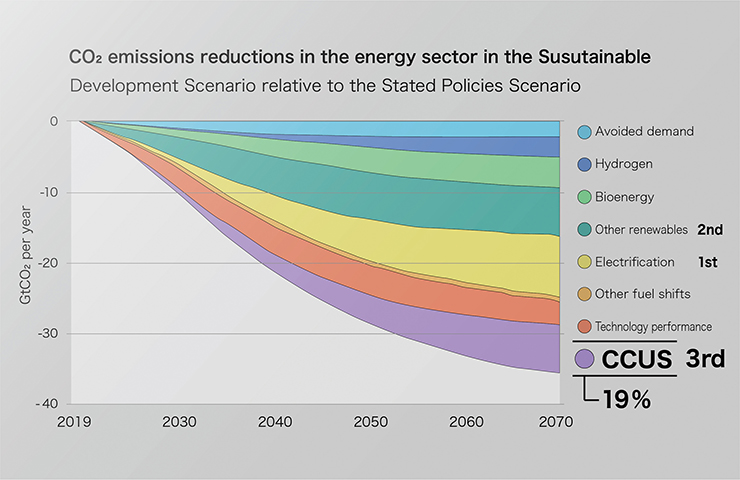
CCU as the next key solution after renewable energy and electrification for decarbonization
CCUS technology is positioned as a major CO₂ mitigation measure following renewable energy and electrification, and the IEA estimates its contribution to CO₂ emissions reductions from energy-related sources at around 19 percent.
Business
Plant Business Bringing the "local production & local utilization" model of CCU plant to the world
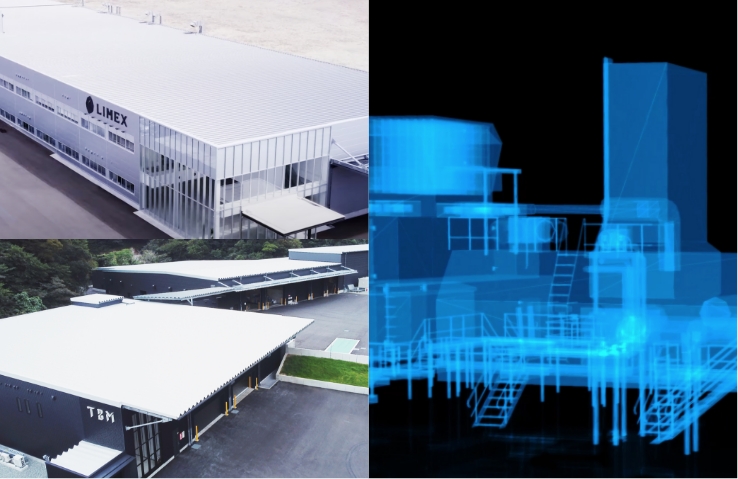
We will establish a “local production, local utilization” model by deploying CCU plants next to CO₂ emission sources and converting CO₂ into resources on-site. Integrating emissions, capture, conversion, and raw material supply minimizes transport energy and intermediate processes, enabling efficient regional CCU. Drawing on design and operational know-how from our Tohoku LIMEX Factory and Yokosuka circular factory, we will offer end-to-end services from plant design and construction to operational support and maintenance, and develop a standard plant model based on optimized CCU technology and processes. With future technology licensing in mind, we will build a system that can be rolled out across industrial hubs worldwide.
Development of CCU products and sales of highly practical products that incorporate environmental value
TBM is developing products that use not only the "CCU material" launched in 2024, but also "CCU calcium carbonate," which balances CO₂ fixation and material circulation. These products, while incorporating a high proportion of calcium carbonate derived from CO₂, ensure practical performance such as moldability, durability, and design, and are being increasingly adopted in a variety of applications as "products with environmental value." In particular, the CO₂ fixation effect is significant in products with long service lives, such as building interior materials and civil engineering materials, and the ability to visualize the CO₂ content through actual use is highly valued. We will promote a business that is not only environmentally valuable but also highly practical. This will create a new standard in CCU market. We will build a new common sense for sustainable manufacturing, realizing a society where environmental performance stands alongside economic rationality.
About Carbon Recycled Products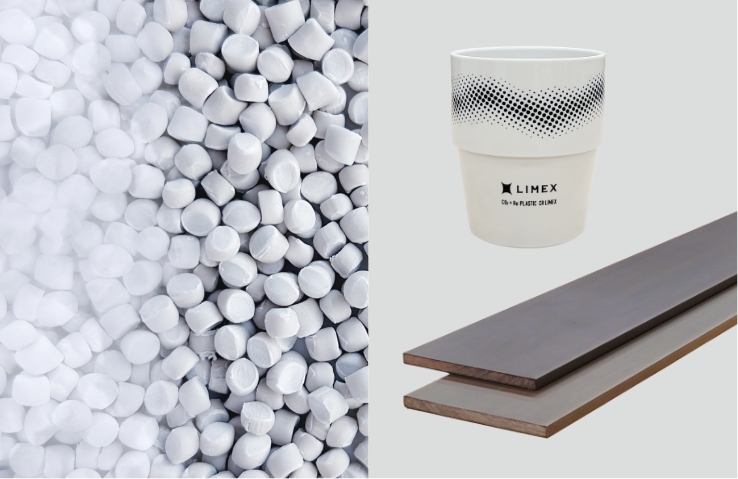
Developing high-value-added raw materialsCreating competitive products from CO₂
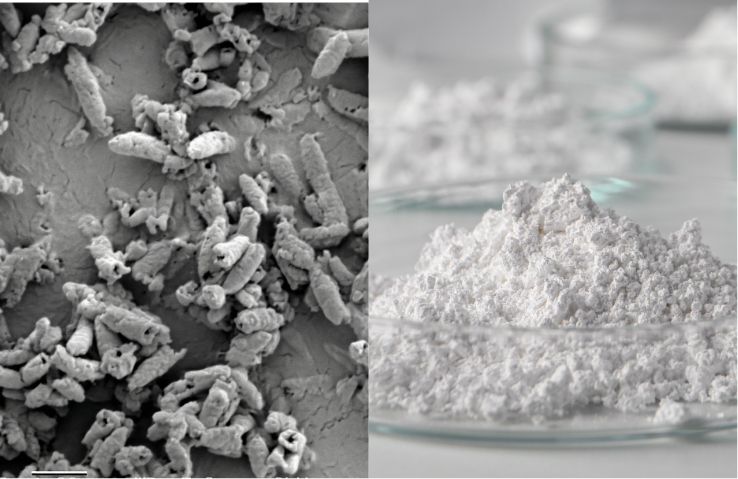
We are developing "CCU Calcium Carbonate (Carbon Capture and Utilization Calcium Carbonate)," which is synthesized using CO₂ that would otherwise be released into the atmosphere. By reacting CO₂ with a calcium source derived from waste to produce calcium carbonate, we are simultaneously achieving a significant reduction in environmental impact and efficient resource utilization. Applying the knowledge of particle size and morphology control technology cultivated with LIMEX, which uses calcium carbonate as a raw material, we will evolve it into a high-value-added raw material whose properties can be customized according to the application. This will make it possible to use it as a raw material in a wide range of applications, such as plastic alternative, paints, and resin additives. Furthermore, by establishing a cost-competitive manufacturing process and a stable supply system, we will push the market for CO₂-derived raw materials to a new stage. It has already been put into practical use by building material manufacturers and others, and sales have begun. We view CO₂ as a new resource and will pioneer the market through the development of high-value-added raw materials that combine environmental value and functional value.
Carbon Credit Creation
Through our plant business and the development and sale of low-carbon materials, we are turning the environmental value generated by our business, such as CO₂ reduction and fixation, into economic value in multiple forms, including carbon credits. By creating both tangible economic value and new financial value through carbon credit, we will drive sustained growth across our business.
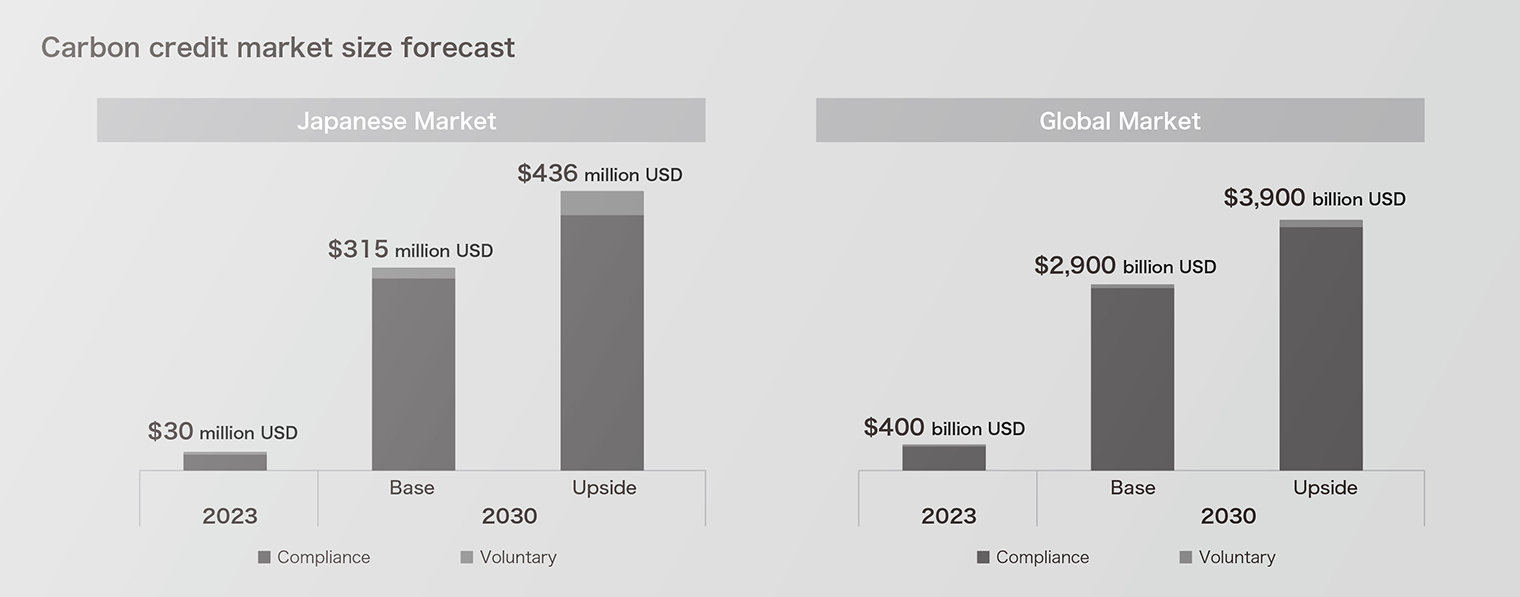
Source: Created by TBM based on various information sources: *1 Yano Research Institute *2 Grand View Research *3 2024 Carbon Credit Market and Price Forecast Consensus Survey (exroad Co., Ltd.) *4 ResearchAndMarkets *5 Morgan Stanley Japan's upside scenario is calculated by multiplying Japan's ratio to the world in the base scenario by the global upside scenario. Converted at 1 USD = 150 yen.
Global Carbon Pricing Trends
Carbon Tax and CBAM
Sweden : A carbon tax has been in place since 1991.
The tax rate is approximately 19,240 yen per ton of CO₂ emissions (as of 2024).
EU (Carbon Border Adjustment Mechanism: CBAM): A system that charges imports from outside the EU (steel, cement, etc.) based on the carbon emissions during manufacturing. (Full-scale implementation is scheduled for 2026.)
Source: Ministry of Economy, Trade and Industry, Agency for Natural Resources and Energy, "Carbon Pricing Trends in Other Countries (February 2024)"
Example of Emissions Trading System
EU (EU Emissions Trading Scheme: EU-ETS): The European Union (EU) operates an emissions trading scheme. The price of emission allowances is around 70 euros (about 11,000 yen) per ton of CO₂ emissions.
Source: ICAP (International Carbon Action Partnership) "Emissions Trading Worldwide: Status Report."
Examples of Carbon Dioxide Removal
Microsoft (purchase of removal credits): Microsoft is in the process of purchasing carbon removal (CDR) credits to meet its 2030 carbon-negative goal.
As an example, the company has entered into an agreement with 1PointFive, Inc. to purchase 500,000 metric tons of credits for Direct Atmospheric CO₂ Capture (DAC) technology (announced in 2024). (announced in 2024)
Source: official Microsoft blog, "Microsoft and 1PointFive announce agreement for direct air capture carbon removal" (July 23, 2024)
Contact
Taking a leading role in CCU is a key source of competitive advantage for companies.
For any inquiries, please use the contact form below.