
Press release
- LIMEX
TBM's "LIMEX Sheet", which uses limestone as the main raw material, has been adopted for the menu list of "Tim Ho Wan" operated by the WDI Group.
- A menu table that does not require lamination and is manufactured with 100% renewable energy to protect water and forest resources -
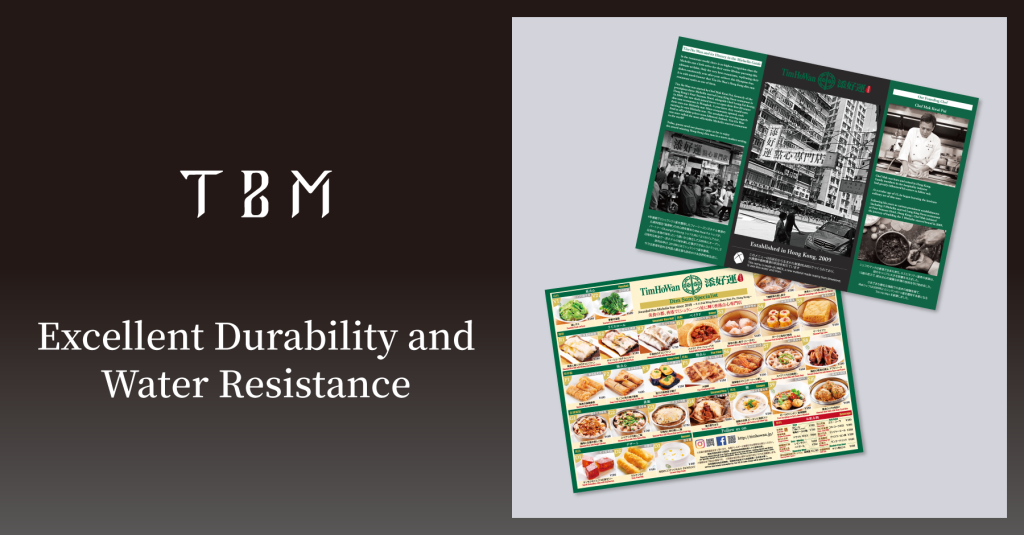
TBM Co., Ltd. (Headquarters: Chiyoda-ku, Tokyo; CEO: Nobuyoshi Yamasaki; hereinafter referred to as TBM) is pleased to announce that “LIMEX Sheet”, which uses limestone as the main ingredient, will be added to the menu list of “Tim Ho Wan”, a Hong Kong dim sum restaurant in Japan (Hibiya store, Shinjuku Southern Terrace store), which has won one Michelin star in Hong Kong and is operated by WDI Co., Ltd. (Headquarters: Minato-ku, Tokyo; CEO: Ken Shimizu; hereinafter referred to as WDI). )” has been adopted.
Compared to plain paper, LIMEX Sheet can significantly reduce the amount of water used during manufacturing, and because it does not use wood pulp as a raw material for the product, it can contribute to the conservation of forest resources. In addition, it does not require lamination processing, such as laminating paper and plastic film, to give it water resistance, and it can be recycled like a product designed with a single material. Menu tables using LIMEX Sheet have already been adopted by major food and beverage chains, and in collaboration with businesses and consumers, efforts are underway to recycle LIMEX Sheet materials using existing mechanical recycling facilities.
This time, we decided to use LIMEX Sheet because of its high recyclability and environmental performance. In the future, TBM will strengthen the sales of LIMEX Sheet, which is an environmentally friendly product, and promote the collection and mechanical recycling of LIMEX products together with partner companies.
LIMEX Sheet Details: https://tb-m.com/limex/products/
Background
Normally, paper production requires water resources and forest resources for paper raw materials. On the other hand, it is expected that 51% of the world's population will be exposed to high water risks *1 by 2050, and approximately 100,000 square kilometers *2 of natural forests will be lost each year from 2015, requiring companies to respond to water and forest resources. At COP26 (26th Conference of the Parties to the United Nations Framework Convention on Climate Change) held in November 2021, the ``Glasgow Summit Declaration on Forests and Land Use'' was announced, and more than 100 countries including Japan (accounting for 86% of the world's forests) have agreed to the goal of eliminating deforestation by 2030.
*1 WWF “Water Risk Scenarios” (2020)|*2 FAO “Global Forest Resources Assessment 2020” (2020)
Features when LIMEX Sheet is used for the menu table
LIMEX Sheet is made by extruding molten LIMEX (a composite material with inorganic filler dispersion containing more than 50% inorganic substances such as calcium carbonate) through a T-die, forming it into a sheet, and then stretching it to create a pore structure inside the sheet that gives it its white color and lightness. LIMEX Sheet is manufactured at the Shiroishi Factory and Tagajo Factory, which use electricity that is essentially "100% renewable energy" and has a "zero CO2 emission coefficient."
Feature 1: Contributes to reducing water, forest resources, and petroleum-based plastics
Compared to regular paper, LIMEX Sheet uses almost no water resources during production and does not use wood pulp as a raw material, which contributes to the conservation of resources at risk of depletion.In addition, because it is durable and water-resistant, it does not require lamination or other processes, and the amount of petroleum-based plastics used can be reduced.
Feature 2: Reduction of processing time and costs
LIMEX Sheet has excellent water resistance, so there is no need for lamination. This reduces the amount of processing time, and can be expected to reduce costs compared to laminated displays.
Feature 3: Clear printing and high-quality texture
LIMEX Sheet features a luxurious matte finish and a high-quality texture. Its excellent color reproducibility makes it suitable for use on restaurant menus.