
Press release
TBM Announces Progress in Material Evaluations of High-Performance Recycled Material “CirculeX” for Automotive Applications in Japan and Overseas
~
CEO Nobuyoshi Yamasaki to Speak at Japan Mobility Show Bizweek 2026 and Present TBM’s Vision
for Turning Circularity into Industrial Competitiveness Through High-Performance Recycled Materials
TBM Co., Ltd. (Headquarters: Chiyoda-ku, Tokyo; CEO: Nobuyoshi Yamasaki; hereinafter “TBM”) today announced that it has completed formulation development meeting the target performance requirements for four of the five recycled plastic material categories published by the Japan Automobile Manufacturers Association, Inc. (“JAMA”): two general-purpose polypropylene (PP) categories and two reinforced PP compound categories. CirculeX is a high-performance recycled material made from post-consumer plastic containers and packaging. TBM is now optimizing formulations to meet the performance requirements of individual original equipment manufacturers (OEMs). Evaluation samples have been supplied and material evaluations are underway at multiple automakers and automotive parts manufacturers, including Tier 1 suppliers, in Japan and overseas.
At Japan Mobility Show Bizweek 2026, held today, October 14, 2026, TBM CEO Atsuyoshi Yamasaki will present the material properties of CirculeX for automotive applications and TBM’s related initiatives. TBM will use this opportunity to expand partnerships with automakers and automotive parts manufacturers in the areas of material evaluation and procurement.
■ Background
As the global shift towards a circular economy progresses, promoting the use of recycled plastics has become a crucial issue for the automotive industry. With the revised Resource Recycling Promotion Act coming into effect in Japan and the ELV (End-of-Life Vehicles) regulations coming into effect in Europe, more than 15% of the plastics used in new vehicles that receive type approval after September 1, 2032, must be recycled material derived from post-use plastic waste* 1. Against this backdrop, automakers and parts manufacturers are required not only to increase the amount of recycled material they use, but also to stably procure recycled material that possess the necessary performance and safety.
recycled material are broadly classified into PIR materials, which use scraps from the manufacturing process as raw materials, and PCR materials, which recycle used products. PIR materials, which are easier to control in terms of quality, are at risk of price increases and supply shortages due to increased demand. On the other hand, PCR materials can utilize plastic packaging waste from households, so a more stable supply of raw materials can be expected than with PIR materials. With the ELV regulations now requiring the use of PCR materials, the importance of PCR materials in the automotive sector is expected to increase even further in the future.
However, PCR materials such as plastic packaging collected from households contain different types of resins and foreign matter, leading to challenges such as reduced strength and durability, odor, quality variability, and management of regulated chemical substances. For this reason, their use has been limited in automotive parts, where high material performance and quality control are required.
TBM has developed "CirculeX," a high-performance recycled material made from container and packaging plastics, to address the challenges of PCR materials, through its unique blending and mixing technologies cultivated in its LIMEX business and improvements to the manufacturing process at Yokosuka circular factory Plant. In TBM's own tests, the target grade has been confirmed to have bending strength and impact strength equivalent to or better than virgin PP* 2. Furthermore, improvements to the washing process and material design have significantly reduced odor compared to conventional PCR materials derived from container and packaging plastics.
Because its strength, fluidity, odor, and other properties can be adjusted for each application, PCR materials are being evaluated by companies both domestically and internationally for use in automotive parts, where their use has previously been difficult.
*1 Regulation(EU)2026/1738:https://eur-lex.europa.eu/legal-content/EN/TXT/?uri=CELEX:32026R1738
*2 Comparison evaluation results with virgin PP in accordance with JIS K 7171 (flexural strength) and JIS K 7111 (Charpy impact strength) (company research). Physical properties are representative values and not guaranteed values. The target grades are "high strength + low odor grade" and "high strength grade".
■ Status of business negotiations and evaluations both domestically and internationally
TBM has developed formulations based on JAMA’s target performance requirements for five categories of recycled plastics for automotive parts, covering general-purpose PP and reinforced PP compounds3Formulation development has been completed for four categories: general-purpose PP for general components, general-purpose PP for door trims and similar components, reinforced PP compounds for instrument panels and similar components, and reinforced PP compounds for undercovers and similar components. In addition to meeting JAMA’s target performance requirements, TBM is optimizing these formulations to meet the specifications of individual OEMs. Evaluation samples are now being supplied and material evaluations are underway.
TBM is also engaged in business discussions with more than 20 companies, including automakers, automotive parts manufacturers such as Tier 1 suppliers, and material and molding-related suppliers in Japan and overseas. In addition to discussing target components, required performance, evaluation conditions, and material grades, TBM is preparing and supplying evaluation samples, supporting material evaluations, and building production capacity to underpin future demand and procurement.
*3 Japan Automobile Manufacturers Association (JAMA) Recycling and Waste Management Committee, April 17, 2026 (Friday), "JAMA's Initiatives to Promote the Use of Recycled Plastic Materials"
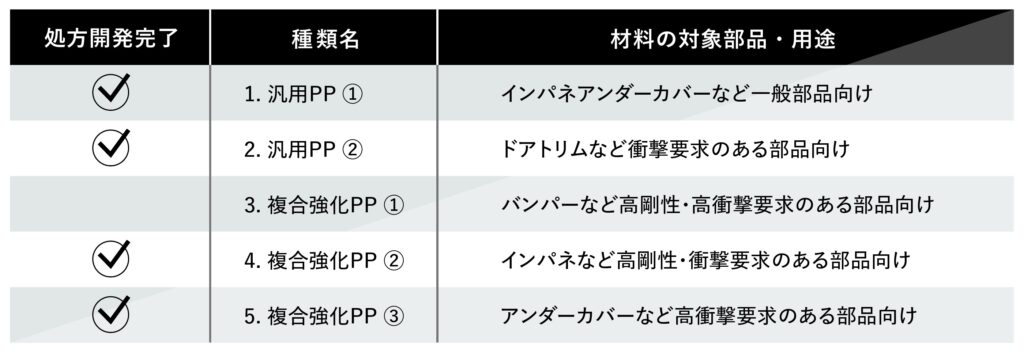
Potential applications include automotive interior components and internal structural components, door-area components, luggage-area components, underbody components such as undercovers, and fender-area components. Depending on the target component and required performance, evaluation items include material properties such as flexural strength and impact resistance, as well as odor, flowability, moldability, durability, and quality consistency. Leveraging the quality management and supply infrastructure of its ISO 9001-certified Yokosuka Circular Factory, TBM will continue to strengthen its production capacity.
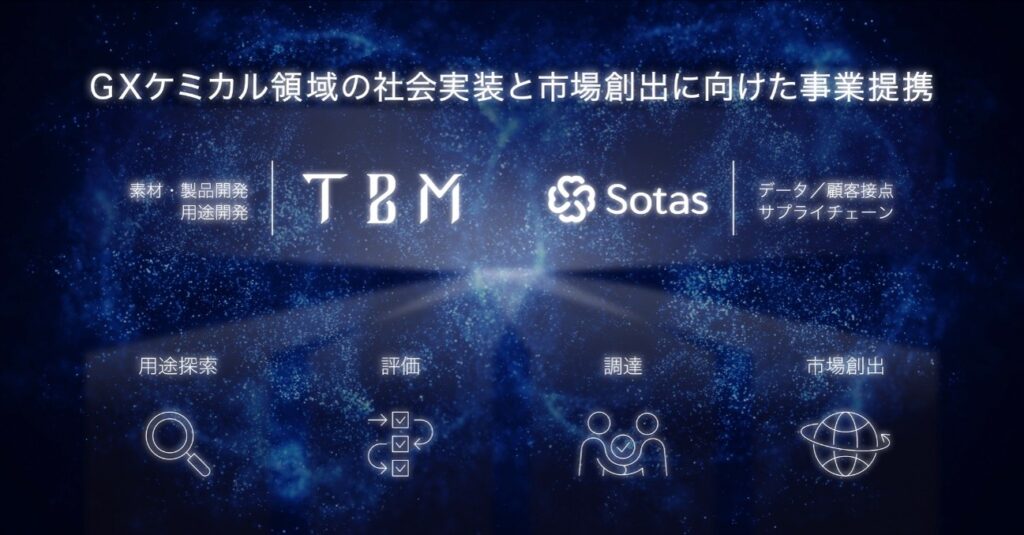
TBM has also signed a memorandum of understanding with Sotas Co., Ltd., which operates the Sotas Database, one of Japan’s largest databases for chemical-industry companies and material information. Under the agreement, the two companies will promote joint marketing and matching for CirculeX and strengthen connections that can lead to procurement.
Related press release:
“TBM and Sotas Sign Memorandum of Understanding to Advance Market Deployment and Creation in the GX Chemicals Sector”
https://tb-m.com/news/news-5828/
In addition, TBM has signed a memorandum of understanding with CLEARIZE Co., Ltd., an independent specialist in analytical services, to jointly develop a chemical-substance management and quality-assurance scheme. This initiative is intended to address the lack of transparency in chemical-substance management, one of the major barriers to the wider distribution of recycled materials.
Press Release: TBM and analytical specialist Clearise sign basic agreement for joint development of chemical management and quality assurance scheme for PCR recycled material
■ Future developments
TBM will incorporate the evaluation results and performance requirements obtained from participating companies into the material design of CirculeX and continue developing and proposing grades tailored to specific automotive components. For automakers, automotive parts manufacturers, and material and molding-related suppliers facing challenges involving the procurement, strength, odor, quality consistency, or chemical-substance management of recycled materials, TBM will provide evaluation samples, design material grades, assist with the study of molding conditions, and support component evaluations. Through material evaluations and application development with partner companies, TBM will advance the use of CirculeX in automotive parts and accelerate the development of a system that circulates plastic waste collected in Japan into high-value automotive applications.
[Contact information for inquiries regarding material evaluation, sample provision, etc.]
Automotive manufacturers, automotive parts manufacturers, material and molding-related suppliers, etc., who are interested in material evaluation, sample provision, application to automotive parts, or joint application development of CirculeX, please contact us via the inquiry form (https://tb-m.com/contact/).
■ About the high-performance recycled material "CirculeX"
"CirculeX" is a high-performance recycled material developed using TBM's unique blending and mixing technology, using container and packaging plastics discarded from households as raw materials. It transforms used plastics, which were previously often incinerated or used for heat recovery, into raw materials for high-value-added products. In our own tests, the target grade has been confirmed to have bending strength and impact strength equivalent to or better than virgin PP. In addition, it has significantly reduced odor compared to conventional PCR materials derived from container and packaging plastics, and we can propose grades with adjusted strength, fluidity, odor, etc., depending on the application. It can reduce greenhouse gas emissions by up to approximately 61% compared to virgin plastics* 4, and we have established a system to manufacture recycled material from used plastics collected domestically, based at Yokosuka circular factory. We are expanding its use to applications where conventional PCR materials were difficult to use, such as automotive parts, furniture, and home appliances.
Learn more about CirculeX here: https://tb-m.com/business/circulex/
*4 Calculation method: Calculated for the entire lifecycle from raw material procurement to manufacturing and incineration. Compared to when 100% virgin plastic is used, and based on the assumption of 100% renewable energy use in the manufacturing process at Yokosuka circular factory