
Press release
TBM's CCU Flooring material has been adopted for the stage at "SusHi Tech Tokyo 2026," organized by the Tokyo Metropolitan Government.
~ Commercialization of building materials containing a high proportion of calcium carbonate derived from CO₂ ~
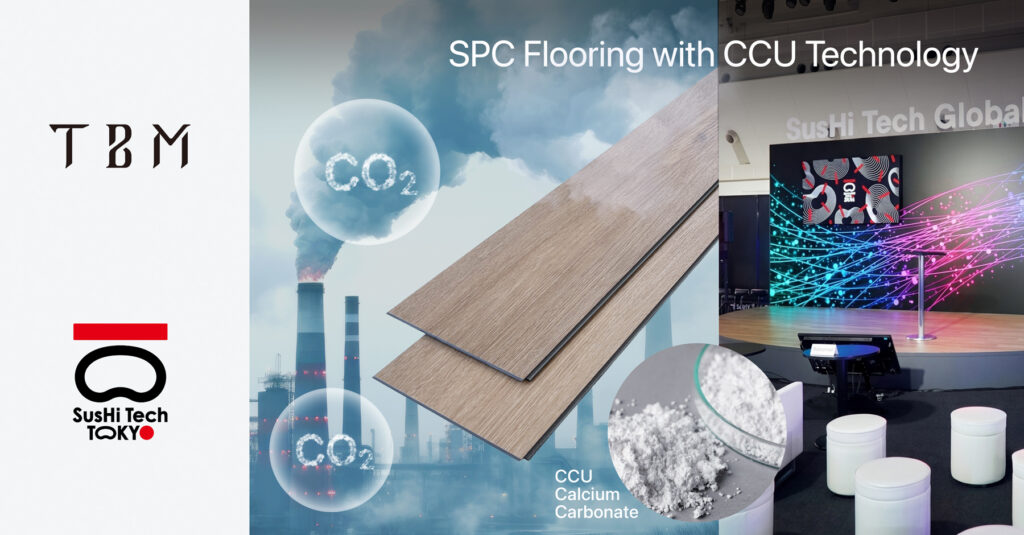
TBM Co., Ltd., Ltd. (Headquarters: Chiyoda-ku, Tokyo; Representative Director and CEO: Nobuyoshi Yamasaki; hereinafter referred to as TBM) is pleased to announce that its flooring material, which utilizes CCU technology to fix CO₂ into the product, has been selected as the stage flooring material for "SusHi Tech Tokyo 2026," Asia's largest innovation conference hosted by the Tokyo Metropolitan Government. TBM has been selected for the Tokyo Metropolitan Government's "SusHi Tech Global Startups" program as a startup with promising global growth potential.
■ Background
Climate change countermeasures have become an urgent global issue, Decarbonization across the entire supply chain, from raw material procurement to post-use recycling and disposal, has become a pressing management challenge for all industries. Cities, in particular, have a significant impact on the environment, with reports indicating that the construction sector (building operation and construction) accounts for approximately 37% of global energy-related CO₂ emissions* 1. Until now, Decarbonization in the construction industry has primarily focused on energy conservation during the building operation phase (operational carbon). However, as buildings become more insulated and equipment becomes more efficient, the proportion of embodied carbon emitted throughout the process from raw material procurement to manufacturing, construction, demolition, recycling, and disposal of building materials is relatively increasing, and its reduction has emerged as a global challenge.
In response to these trends, the EU amended the Energy Performance Directive for Buildings (EPBD) in 2024, making it mandatory from 2030 for all new buildings to calculate and disclose their global warming potential (GWP) over the entire lifecycle, thus strengthening regulations aimed at reducing emissions from buildings as a whole, including building materials* 2. In Japan, the Ministry of Land, Infrastructure, Transport and Tourism is also working on designing a system to make it mandatory by fiscal year 2028 for buildings above a certain size to calculate and report CO₂ emissions (LCCO₂) throughout the entire process from construction to demolition* 3.
*1 UNEP (United Nations Environment Programme): 2022 Global Status Report for Buildings and Construction
*2 European Commission: Energy Performance of Buildings Directive
*3 Ministry of Land, Infrastructure, Transport and Tourism: Future Directions for Energy-Saving Measures in Buildings Towards the Realization of a Decarbonization Society (Roadmap)
■ Overview of this matter
The flooring material used at "SusHi Tech Tokyo 2026," Asia's largest innovation conference, contains approximately 75% (by weight) of CCU calcium carbonate *1, which is produced by chemically fixing CO₂ contained in exhaust gases from factories and other sources that would otherwise be released into the atmosphere. By using this CO₂-fixed flooring material, it contributes to reducing embodied carbon compared to using conventional polyvinyl chloride (PVC) flooring materials.
Furthermore, it boasts superior durability compared to conventional PVC flooring materials, and its click-type installation method, which does not require adhesives, shortens construction time, thus achieving a balance of functionality and practicality as well as environmental performance.
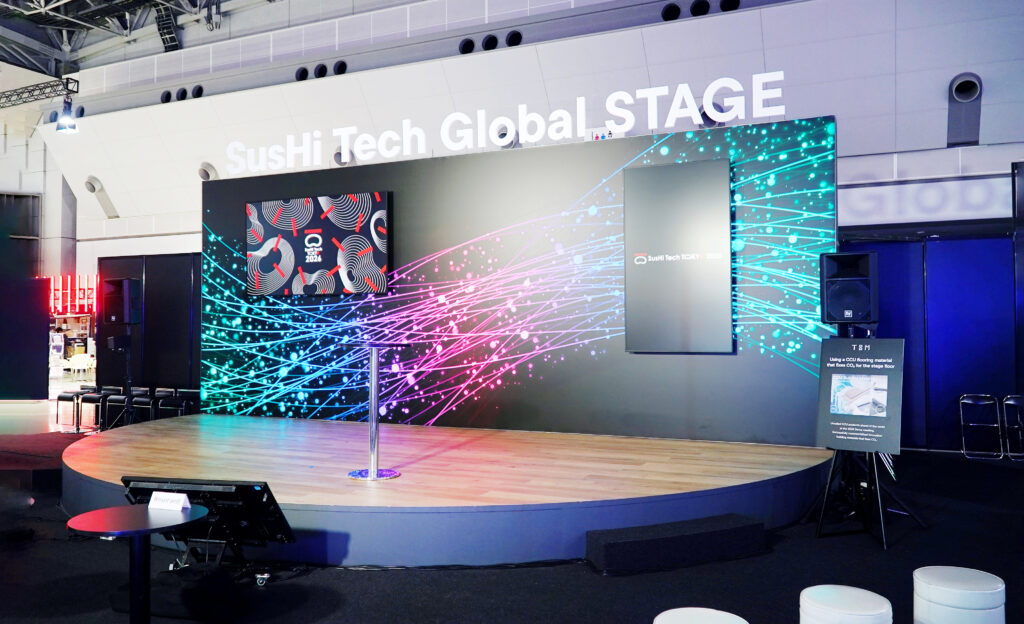
This product is being used as flooring for the "SusHi Tech Global Stage" at the event venue. TBM will continue to promote the development and dissemination of flooring materials and a variety of green building materials that contribute to urban Decarbonization in the housing and construction sectors, where compliance with legal regulations is required.
*1 CCU: Carbon Capture and Utilization (CO₂ recovery and reuse)
■ Features of this flooring material
- Using flooring materials with fixed CO₂ makes it possible to reduce embedded carbon.
Because this flooring material contains a high concentration of calcium carbonate, which is chemically synthesized using CO₂ that would otherwise be released into the atmosphere as exhaust gas, at a rate of 75% by weight, using this flooring material leads to a reduction in embedded carbon compared to conventional PVC flooring materials. Approximately 3 kg of exhaust gas-derived CO₂ is sequestered per square meter of product, and approximately 100 kg of CO₂ is sequestered in an area of 20 tatami mats.
• High rigidity, excellent dimensional stability, and durability
By filling the material with a high concentration of inorganic calcium carbonate (CCU), its rigidity is enhanced. As a result, compared to conventional PVC flooring materials such as LVT (Luxury Vinyl Tile), expansion and contraction due to temperature changes are suppressed, resulting in excellent dimensional stability, as well as high resistance to dents from heavy objects and to water and moisture.
- Reduced construction time and costs through faster construction.
The click-fit installation method, which requires no adhesive and simply involves snapping the tongue and groove together, improves installation efficiency. It can also be used as an overlay on existing flooring, making it suitable for tenants undergoing renovations or restoration work. Shorter construction periods contribute to reduced construction costs, including labor costs.
- Improved functionality through high design quality and surface treatment
It employs EIR (Embossed Infrared) technology, which realistically reproduces the texture of wood grain and stone. In addition, the surface is UV coated, making it resistant to scratches and stains, and it has excellent water resistance and water resistance, making daily maintenance easy.
For more details about this flooring material, please visit: https://tb-m.com/doc/Building-Material-Leaflet
[Inquiries and Orders]
If you are an architectural firm, house builder, developer, or representative in the renovation/interior design industry considering the use of this flooring material or new Decarbonization initiatives in the housing and construction sectors, please contact us via the inquiry form (https://tb-m.com/contact/).
(Related site) About "SusHi Tech Tokyo 2026": https://sushitech-startup.metro.tokyo.lg.jp/
■ TBM's CCU business
TBM aims to solve global environmental and social issues by transforming the large amounts of CO₂ emitted in various regions of the world into a valuable "resource," supplying that resource as environmentally friendly raw materials and materials, and developing CCU (Carbon Capture and Utilization) plants adjacent to CO₂ emission sources, thereby building a "local production for local use" model for CO₂ resource utilization. TBM launched CCU products in 2024, approximately 15 years ahead of the government's roadmap at the Davos Conference. It has already obtained patents and its products have been adopted as official licensed products for the Osaka-Kansai Expo. Furthermore, its advanced efforts in the practical application of CO₂ fixation technology have been featured in a white paper on CCU by the World Economic Forum. Specifically, TBM collaborates with businesses that emit large amounts of CO₂ (such as thermal power plants and steel mills) to recover CO₂ emitted from these businesses using CCU technology, and then chemically reacts it with waste-derived calcium to produce CCU calcium carbonate. This calcium carbonate, recycled from CO₂, will be used as a raw material for building materials such as interior and exterior finishes. Furthermore, the "environmental value" generated by the business cycle, such as CO₂ reduction and sequestration, will be created as carbon credits. This will enable businesses with high CO₂ emissions to reduce their emissions, and enable companies using the material to reduce the environmental impact in their supply chain and secure a stable supply of low-carbon material. Through this scheme, we will contribute to achieving carbon neutrality for society as a whole.