
Press release
- TBM
- Recycling Plant
TBM and Yokosuka City are the first in the country to respond to the "New Plastic Law", and start collaborative efforts to collectively collect, recycle and recycle LIMEX products, container packaging plastics, and product plastics discharged from households in the city.
- Promoting mechanical recycling of LIMEX products, which are products that use plastic -
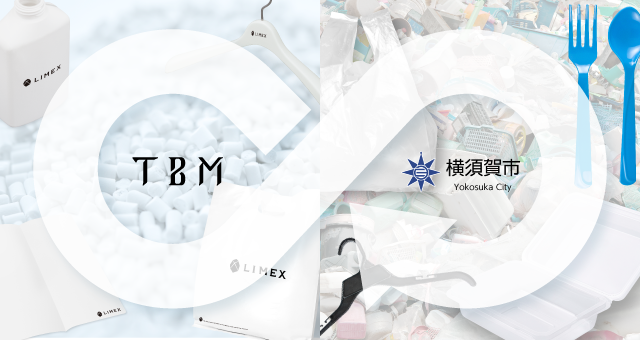
TBM Co., Ltd., Ltd. (Head office: Chiyoda-ku, Tokyo; Representative Director and CEO: Nobuyoshi Yamasaki; hereinafter referred to as TBM) is collaborating with Yokosuka City, Kanagawa Prefecture, which has declared itself a "Zero Carbon City," to implement the "Act on Promotion of material circulation of Plastics," which will come into effect in April of this year. In order to comply with the New Plastics Law (hereafter referred to as the "New Plastics Law"), we will proceed with initiatives such as formulating recycling plans, collecting and recycling waste in bulk, and conducting demonstration experiments on recycling.
Until now, plastic container and packaging waste has been collected and recycled in accordance with the Containers and Packaging Recycling Law. Meanwhile, plastic product waste other than plastic containers and packaging has been disposed of as combustible waste. The new Plastics Law aims to increase the amount of plastic resource recovery by having local governments set easy-to-understand sorting rules for citizens, and has established a system that allows waste plastic products other than plastic containers and packaging to be recycled according to the circumstances of each local government.
Environmentally friendly LIMEX products, which fall under the category of plastic-containing products under the New Plastics Act, are currently being used by over 8,000 companies and local governments for a variety of purposes, including as plastic alternative for grocery bag, stationery, and food containers, as well as paper alternative for printed materials such as booklets and posters. LIMEX is a composite material primarily composed of inorganic substances such as calcium carbonate and thermoplastic resin. However, since it can be recycled using existing equipment without separating the inorganic and thermoplastic resin components, LIMEX products can be recycled in the same way as products designed with a single material. Furthermore, to make sorting easier for both businesses and general consumers, guidelines* are in place for labeling product materials, allowing them to be identified by a stone mark.
As LIMEX products become more widespread and the domestic disposal of waste plastics has become a major social issue, last year TBM announced a project to operate one of Japan's largest mechanical recycling plants, scheduled for completion in Yokosuka City this fall, and has been working to build a system that will not only recycle used LIMEX, but also recycle waste plastics. Going forward, TBM will work with Yokosuka City to achieve a Decarbonization society by promoting material circulation material circulation, with an eye toward implementing the comprehensive collection, recycling, and re-commercialization of LIMEX products, plastic containers and packaging, and plastic products throughout the city in fiscal 2023.
Overview
1. The first nationwide collaboration in response to the enforcement of the Plastic material circulation Promotion Act
TBM will work with Yokosuka City to take the lead in the country in the following initiatives in response to the new Plastics Act, which will come into effect in April 2022. Going forward, we will work on various initiatives, including concluding a comprehensive partnership agreement with Yokosuka City, to realize Decarbonization society through the promotion of material circulation.
(1) Formulation of a recycling plan
We will work with Yokosuka City to develop a recycling plan based on the new Plastics Act, and will consider collecting LIMEX products, plastic containers and packaging, and plastic products discarded from households in Yokosuka City, and recycling and re-commercializing them all at once.
(2) Conducting demonstration experiments
In conjunction with the planned start of operation of the TBM-operated plant in the fall of 2022, a model area will be established within Yokosuka City to conduct a demonstration experiment on the bulk collection and recovery of LIMEX products, plastic container packaging, and plastic products, which fall under the plastic-containing products specified in the New Plastics Act, as well as recycling and re-commercialization processing.
*We plan to enter the Ministry of the Environment's "Advanced Model Formation Support Project for Plastic material circulation" in fiscal year 2022.
2. Considering the use of LIMEX
We will proceed with discussions with Yokosuka City about the utilization and collection of LIMEX products at the city hall.
Examples of considering the use of LIMEX products
・Booklets such as plans
・Publicity posters and leaflets
·name card
・ Novelty goods for events, etc.
* Collection boxes are installed at the city hall main building and the administrative center.
3. Promotion of material circulation (recycling) education
We will work with Yokosuka City to raise awareness about mechanical recycling initiatives and LIMEX products that we will promote in the future, through tours of TBM operating plants, visiting classes at elementary and junior high schools, and garbage talks with neighborhood associations and business operators. .
Four. Expected effects of efforts
By proceeding with this initiative, we will be able to reduce the amount of combustible waste and reduce CO emissions. 2 It helps reduce emissions. If 1 ton of plastic waste included in the current combustible waste is removed, approximately 2.7 tons of CO will be generated. 2 Emissions can be reduced. It is estimated that the amount of plastic waste contained in burnable garbage in Yokosuka City is approximately 2,000 tons per year. 2 A reduction in emissions is expected as an effect.