Press release

  • MaaR

Launch of "Maar recycled material Procurement," a platform that supports recycled material procurement compatible with digital product passports

- Providing traceability and GHG emissions information, etc., to expand demand for recycled material and recycling-conscious products -

TBM Co., Ltd., Ltd. (Head office: Chiyoda-ku, Tokyo; Representative Director and CEO: Nobuyoshi Yamasaki Yamazaki; hereinafter referred to as TBM) will begin offering "Maar Recycled Material Procurement," a platform that supports the procurement of recycled materials and raw materials (hereinafter referred to as "recycled material materials, etc.") with traceability information, etc., by utilizing the Digital Product Passport* (hereinafter referred to as DPP) system and the MSP system (recycled material database) provided by RadarLab Inc. (Head office: recycled material ku, Tokyo; Representative Director: Na-recycled material Woo; hereinafter referred to as RadarLab).


"Maar recycled material Procurement" official website: https://maar-sourcing.tb-m.com/top

・Registration page for purchasing companies (free registration): https://maar-sourcing.tb-m.com/form/buyer

・Registration page for sales companies (free registration): https://maar-sourcing.tb-m.com/form/seller


Against the backdrop of growing demand for recycled material and environmental awareness in the global market, governments, industries, and companies around the world are being called upon to shift to a circular economy, including efforts to comply with DPP in the EU's proposed ecodesign regulations.

The newly announced "Maar recycled material Procurement" initiative promotes recycled material procurement by product and molding manufacturers, and by utilizing the DPP system, product and molding manufacturers, as well as waste plastic generators, recycled material, and recycled material in the supply chain, will be able to visualize traceability information, recycled material utilization rate, greenhouse gas (GHG) emissions, and other DPP-compliant information required by the EU's proposed Ecodesign Regulation. Furthermore, by disclosing information when recycled material is purchased or sold, both the seller and purchaser of recycled material will be able to easily aggregate the data required for DPP on the platform, eliminating the need for expensive system investment and implementation on their own. By supporting DPP compliance for recycled material and products made with recycled material recycled material, the platform will support the creation of traceable products and encourage consumers to purchase products based on circular design.


* A Digital Product Passport (DPP) is an electronic record that provides access to a product's entire life cycle, from raw material procurement to recycling. By collecting data on manufacturing and its supply chain (recycled material content, GHG emissions, materials used, disposal methods, traceability information, etc.) and sharing it throughout the value chain, the aim is to enable all stakeholders, including consumers, to purchase products and materials with an understanding of their environmental friendliness.


◾️Background

Globally growing recycled material market

The shift from a linear economy to a circular economy is a global trend. The global recycled plastics market is expected to grow from $50.78 billion in 2023 to $88.96 billion in 2030, with a compound annual growth rate of 8.3% during the forecast period*1. Individual companies have set targets for increasing the proportion of recycled material they use, but among the companies participating in the New Plastics Economy Global Commitment, the top 10 brands and manufacturers by plastic consumption are expected to need to supply more than 3 million tons of recycled material per year to achieve their 2025 targets*2.

*1 https://www.fortunebusinessinsights.com/recycled-plastic-market-102568

*2 https://www.ellenmacarthurfoundation.org/global-commitment-2023/overview

-Policies in various countries accelerating corporate initiatives

Governments around the world are also announcing policies to promote the use of recycled material. In Europe, the Ecodesign Regulation published by the European Commission in March 2022 stipulates compliance with DPP, and is expected to be approved in 2024. Since the EU will require all products sold to be accompanied by DPP, companies selling products to Europe are likely to be forced to fully comply with the regulations. In Japan, the Ministry of Economy, Trade and Industry (METI) formulated a "Growth-Oriented Resource Autonomy Economy Strategy" in March 2023, provided GX investment support to accelerate arteriovenous collaboration, and is considering the launch of a circular economy information distribution platform. Along with the promotion of ecodesign and growing demand recycled material both domestically and internationally, there is a growing need for visualization of information on contained substances, physical properties, processing, quality, and other information.


◾️TBM's material circulation initiatives

TBM has operated one of Japan's largest mechanical recycling plants, collected plastics and sold recycled plastics through collaboration with over 100 recycling partners nationwide, planned products using recycled material "CirculeX," and sold recycled plastics overseas, primarily in Southeast Asia. In 2023, the company obtained the "Global Recycled Standard Certification" and "Recycled Claim Standard Certification," international certification programs for recycled products established by the American non-profit organization "Textile Exchange." recycled material matching business, which began in 2021, is currently generating annual transactions of 34,000 tons.


■ Features and usage of "Maar recycled material procurement"

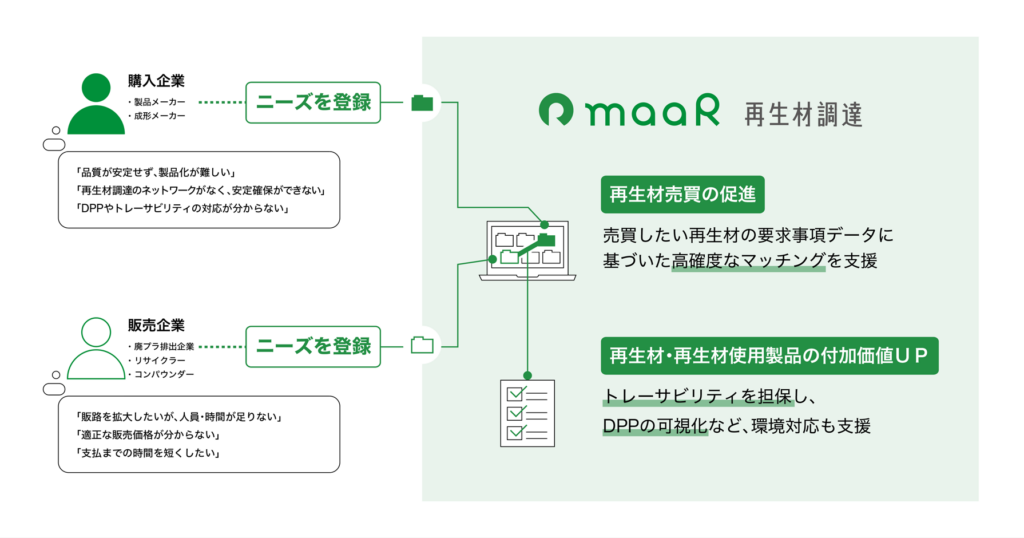
Maar recycled material Procurement utilizes the DPP system to increase the added value of recycled material and promote the spread of traceable recycled material and products made from recycled material. Companies that manufacture products using recycled material, such as product and molding manufacturers, and companies that sell recycled recycled material, such as waste plastic producers, recyclers, and compounders, register the requirements for recycled material they wish to buy and sell within the service. TBM's sales staff, with their extensive know-how and experience gained through their material circulation efforts, will support each recycled material transaction, enabling highly accurate matching of recycled material transactions. The service also plans to handle household recycled material produced at Yokosuka circular factory, mechanical recycling plant completed in November 2022.

▼Benefits for purchasing companies

1. Contributing to QCD (quality, cost, delivery time) in recycled material procurement

We promote the procurement of recycled material at fair prices through transactions based on the registered data of recycled material sellers, such as waste plastic producers, recyclers, and compounders. This allows for smooth sample delivery and property testing, enabling stable purchase of recycled material you need at the right time.

2. Improving the efficiency of recycled material procurement

Support from sales personnel specializing in recycled material procurement streamlines operations and centralizes billing procedures, ensuring safe and stable transactions.

3. Promoting traceability/DPP environmental friendliness

We respond to the environmentally friendly manufacturing demands both in Japan and overseas, and support everything from purchasing traceable recycled material to DPP compliance for final products.


▼Benefits for sales companies

1. Expanding sales channels and stabilizing sales volume

Our sales staff will support you in securing buyers for recycled material /recycled recycled material materials based on the requirements data of Japan's largest recycled material purchasing companies. In addition, by conducting transactions that meet your needs, you can expect to sell at higher unit prices than before.

2. Providing information on recycled material market

Simply register the recycled materials and recycled material you are able to sell and we will create a simple quote for recycled material you have registered. We will also regularly provide you with real information on recycled material market.

3. Increasing the added value of recycled material

By ensuring traceability and complying with environmental standards that manufacturers will require in the future, such as DPP compliance, we will be able to sell at high unit prices.