
Press release
- LIMEX
"Bio LimeAir Bag," made with limestone and plant-derived resin, adopted as DCM Group's grocery bag
- Reduces petroleum-based plastics and CO2 emissions, contributing to efforts to reduce environmental impact -
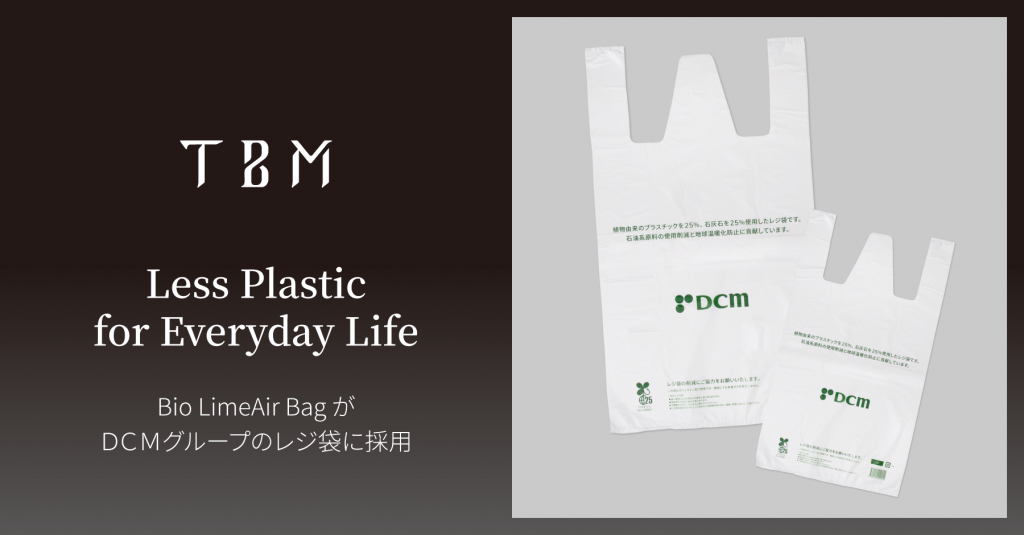
TBM Co., Ltd., Ltd. (Head office: Chiyoda-ku, Tokyo; Representative Director and CEO: Nobuyoshi Yamasaki; hereinafter referred to as TBM) has adopted its "Bio LimeAir Bag," a bag containing approximately 25% limestone and biomass plastic, as grocery bag used by DCM Co., Ltd. (Head office: Shinagawa-ku, Tokyo; President and CEO: Yasunori Ishiguro; hereinafter referred to as DCM) at DCM Group stores (DCM, DCM Kama, DCM Daiki, DCM Homac, DCM Sanwa, DCM Kuroganeya, and Keiyo Day Two). The bags will be gradually introduced in stores from August 2022.
By switching from the bags that DCM previously used, which contain approximately 25% biomass plastic, to Bio LimeAir Bags, it is expected that the amount of petroleum-based plastics used will be reduced by approximately 41% annually, and greenhouse gas emissions, including CO₂, will be reduced by approximately 27%. *1 Going forward, TBM will promote the introduction of Bio LimeAir Bags in the retail industry, where efforts to rationalize plastic use and Decarbonization are accelerating.
*1 Approximate calculation by TBM (from raw material procurement to incineration disposal). This is not a guaranteed value and may vary depending on manufacturing conditions, etc.
Background
There is a growing movement both domestically and internationally to restrict single-use plastics, with over 127 countries *2 already restricting the use of grocery bag, and the European Union (EU) has passed a bill banning single-use plastics. In Japan, as part of a strategy to comprehensively promote plastic material circulation, a mandatory fee for grocery bag was introduced in July 2020. Furthermore, with the enforcement of the Act on Promotion of material circulation Related to Plastics on April 1, 2022, businesses that use plastic are being asked to use alternative materials or recycled plastics.
In response to the introduction of grocery bag charge in July 2020, DCM switched from using polyethylene grocery bag to grocery bag containing approximately 25% biomass plastic, which has a low environmental impact, and has reduced the number of grocery bag used by 85%. While considering grocery bag with an even lower environmental impact, DCM decided to adopt Bio LimeAir Bag, as its environmental performance and functionality were highly evaluated.
*2 United Nations Environment Programme (2018). Legal Limits on Single-Use Plastics and Microplastics: A Global Review of National Laws and Regulations
3 Features of Bio LimeAir Bag
The BioLimeAir Bag is a bag containing 25% limestone and biomass plastic. By utilizing calcium carbonate uniform dispersion technology and void control technology, we have been able to create a bag that is lighter and has better environmental performance than bags containing approximately 25% biomass plastic.
Feature 1: Reduces the amount of petroleum-based plastics used
Compared to bags containing approximately 25% biomass plastic, the Bio LimeAir Bag can reduce the amount of petroleum-based plastics used by approximately 41%.
Feature 2: Reduces greenhouse gas emissions, including CO₂
Compared to bags containing approximately 25% biomass plastic, Bio LimeAir Bags can reduce greenhouse gas emissions, including CO₂, from raw material procurement to disposal by approximately 27%.
Feature 3: Lightweight with void control technology
The Bio LimeAir Bag is lighter than bags that contain approximately 25% biomass plastic.