
Solving the problems associated with paper.
The frequent need to replace posters due to tears or sun damage has been eliminated.
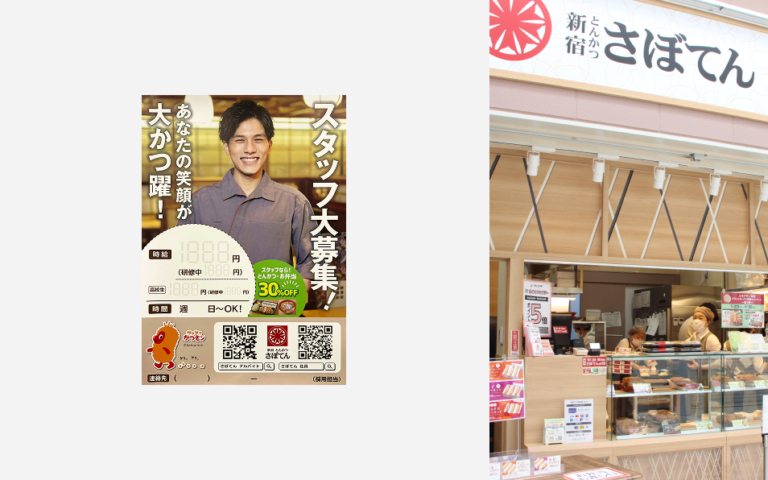

- Company name:Tonkatsu Shinjuku Saboten (Green House Foods Co., Ltd.)
- Industry:Food and Beverage
- Applications forprinted matter
- URL:Green House Foods HP
table of contents
- Challenges, adopted products, and effects
- I learned about LIMEX on TV. I had a hunch that it could solve the problems with recruitment posters.
- Its functionality—"tear-resistant, sun-resistant"—spurred its unprecedented adoption.
- Significantly reduces on-site workload. Zero replacements due to damage.
- We also expect it to expand into new uses, such as menus.
- 【assignment】
- Improving the frequency of replacing paper posters due to fading and deterioration from sun exposure.
- [Products that were selected]
- Job posting poster
- 【effect】
- This significantly reduces the effort required for on-site staff to change posters.
- By using no wood pulp as a raw material for the product, the amount of water required during manufacturing is significantly reduced, contributing to the conservation of natural resources.
The Green House Group operates tonkatsu (pork cutlet) specialty restaurants such as "Tonkatsu Shinjuku Saboten" and Chinese restaurants such as "Xie Peng Dian," and engages in comprehensive business development related to food and hospitality. The company has introduced "LIMEX," which is made primarily from limestone, as a material for recruitment posters in its recruitment activities.
This time, we spoke with Ms. Kasahara, who is in charge of recruitment support for the Green House Group, about the background to the introduction of LIMEX and its effects.
Kasahara's Profile
I belong to the Recruitment Support Department of the Greenhouse Group. I am in charge of recruitment support for the entire group, including Greenhouse Foods, and I am engaged in a wide range of human resources-related tasks, such as hiring experienced professionals and part-time staff.
I learned about LIMEX on TV.
"I had a hunch that this could solve the problems with job posting posters."
- What was theきっかけ (trigger/reason) that led you to learn about LIMEX?
-
Mr. Kasahara
I first learned about LIMEX from the TV program "Gacchiri Monday!!". I think it was around 2017. At the time, I was in charge of recruiting part-time workers in the sales promotion department of Green House Foods, and one of my tasks was creating recruitment posters.
Traditional paper posters would tear after being displayed for a while, and especially in street-level stores, they would fade from sun exposure, resulting in frequent replacements due to deterioration. That's when I happened to see LIMEX on TV and instinctively thought, "This will last a long time." So, I called your company immediately after watching the broadcast to inquire.
"Tear-resistant, sun-resistant"—its functionality...
Supporting an unprecedented implementation
- After you contacted us, how did the process proceed from initial inquiry to implementation?
-
Mr. Kasahara
We had a sales representative come in, and we initially considered using it for posters and business cards. However, we found that the ink wouldn't adhere to the business cards on the printer we were using at the time, so we abandoned that idea. Therefore, we decided to proceed with the introduction of LIMEX, at least for the recruitment posters, which were the biggest challenge for us.
To be honest, at the time (2017), no one in the company knew about LIMEX. In the proposal, we listed its features such as "tear-resistant" and "water-repellent," and explained that it would last longer, thus reducing the frequency of replacements.
- Were there any concerns regarding costs?
-
Mr. Kasahara
Regarding the higher cost compared to paper, we believed it was well worth it considering the reduced frequency of replacements and reprints in the future. Our top priority was ease of use for the stores, that is, the functional benefit of "durability."
Significantly reduces on-site workload. Zero replacements due to damage.
- What kind of results have you seen since actually implementing LIMEX posters?
-
Mr. Kasahara
First, a major advantage was that the posters "don't get dirty," "don't tear," and "don't fade in the sun." In particular, many of our delicatessen stores are street-level and are often exposed to rain and wind. Paper posters would deteriorate quickly, but this problem has been solved, and the hassle of replacing them has been reduced.
- How much has the frequency of replacement changed?
-
Mr. Kasahara
Previously, we frequently had to replace the signs due to tears and stains. Since switching to LIMEX, we no longer need to replace them due to damage, and replacements are now only necessary when we change the hourly wage notation due to wage revisions, which is basically about once a year. As long as there are no changes to the content, they can be used without any problems for a year. I think this has significantly reduced the amount of work our on-site staff have to do for replacements.
We also expect it to expand into new uses, such as menus.
- Please let us know if you have any honest opinions or requests regarding the products you are currently using or regarding our company.
-
Mr. Kasahara
There are no particular areas that we would like to see improved. However, we have seen examples of other companies using LIMEX as menu boards in family restaurants, and we feel that it could be used in our own business as well. Depending on the type of business, for example, menus placed on tables can get stained by customers spilling drinks on them, or the corners can get bent. If it is possible to make something similar with LIMEX, we think there is potential for it.
Green House Foods, recognizing the functionality of LIMEX, which is resistant to deterioration even in outdoor environments, has successfully solved on-site challenges. TBM will continue to support the company's smooth store operations and recruitment activities by providing LIMEX products.