Press release
- LIMEX
- TBM
- Tohoku LIMEX factory
TBM signs comprehensive partnership agreement with Tagajo City on sustainable urban development
~ Collaboration in efforts to demonstrate and implement CCU materials and environmentally friendly materials and products ~
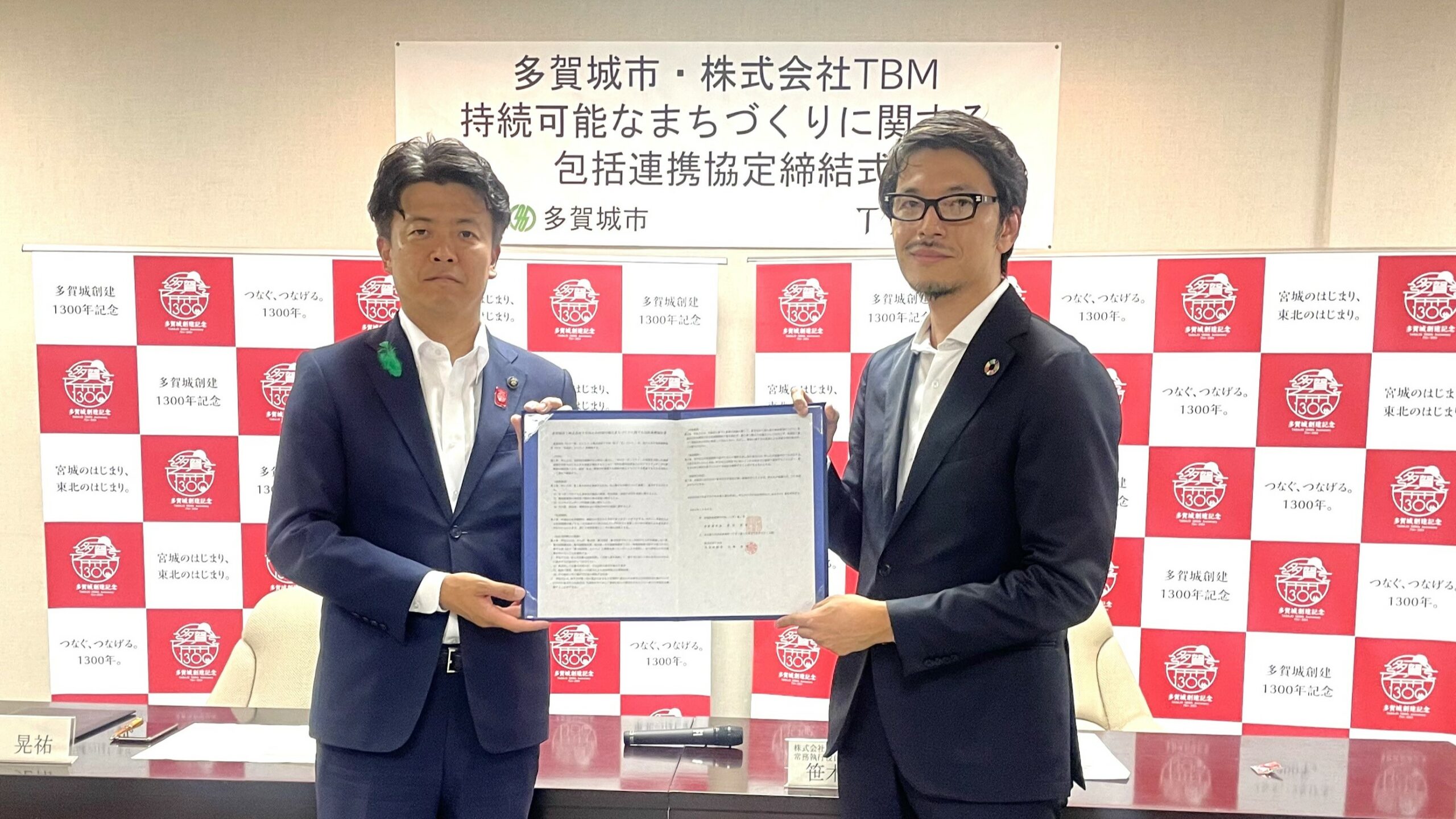
TBM Co., Ltd. (Headquarters: Chiyoda-ku, Tokyo; CEO: Nobuyoshi Yamasaki; hereinafter referred to as TBM) and Tagajo City, Miyagi Prefecture (Mayor: Kosuke Fukaya) are pleased to announce that they have concluded a comprehensive partnership agreement with the aim of strengthening their mutual collaboration to strengthen efforts, including global warming countermeasures aimed at realizing a "zero carbon city," as well as to promote sustainable urban development in which the economy, society, and environment are in a virtuous cycle through business matching with local companies and entrepreneurs and the creation of new businesses. To mark the signing of this agreement, a signing ceremony was held at Tagajo City Hall on October 8, 2024.

Background
In recent years, as environmental issues and climate change have become more apparent, companies and local governments are being asked to address various social issues, such as contributing to the Sustainable Development Goals (SDGs) and issues related to material circulation of plastics and other materials.
With the support of the Ministry of Economy, Trade and Industry, TBM completed construction of the Tohoku LIMEX Plant (Tagajo city, Miyagi Prefecture), a mass production plant for the environmentally friendly material LIMEX, in 2021, and is working to promote the use of LIMEX materials and LIMEX products both in Japan and overseas, with more than 10,000 companies and other entities having adopted these materials. At the World Economic Forum's annual meeting (Davos Forum) held in January of this year, we announced a new material, CR LIMEX, which is made from CO2-derived calcium carbonate, utilizing CCU technology. Currently, trial production of "CR LIMEX" is underway at the Tohoku LIMEX Plant in preparation for mass production.
In addition, TBM has established Resource Recycling Council, with the aim of creating an internationally competitive material circulation market. Through collaboration with over 190 companies and organizations (as of October 2024) that are key players in material circulation, the council is promoting circular economy and climate change countermeasures by proposing necessary policies and legal frameworks, demonstrating, implementing, sharing, and disseminating effective material circulation models. Toward the realization of a Decarbonization society, Tagajo City has declared itself a "Zero Carbon City," aiming to achieve net-zero carbon dioxide emissions from Tagajo city by 2050. The council is promoting global warming countermeasures that take into account the city's natural and social conditions.
The policy of Tagajo City, which is working to reduce greenhouse gas emissions that cause climate change, and TBM's business activities, which are working to realize a Decarbonization, recycling-oriented society through LIMEX and CR LIMEX, etc., coincide with each other, leading to the conclusion of a comprehensive partnership agreement.
* Resource Recycling Council: An organization that works with government agencies to create an internationally competitive material circulation market that transcends the boundaries of industries and companies.
URL: https://rrc.or.jp
■ Overview of the comprehensive partnership agreement
Under this agreement, TBM and Tagajo City will cooperate with each other and advance initiatives in the following collaborative areas:
<Major initiatives>
1. Development of CCU materials and products, and efforts toward social demonstration and implementation
・Product development aimed at popularizing low-carbon material "CR LIMEX" products that utilize CCU technology.
We will proceed with social demonstration and implementation.
2. Promoting the spread of environmentally friendly materials and products
・We will raise awareness and promote the use of environmentally friendly materials and products.
3. Business matching and startup support
・Collaborating with Tagajo City's co-creation and startup support projects to help create a startup ecosystem.
Supporting business matching and entrepreneurship through materials
・Cooperation in various public awareness activities
4. Other initiatives aimed at realizing a Decarbonization, recycling-oriented society
・Support for environmental awareness projects, seminars and training for environmental education, etc.
・Cooperation in activities to raise awareness of Decarbonization management among businesses in the city
・Support for local businesses in calculating carbon dioxide emissions and support for small and medium-sized enterprises in obtaining SBTs
With this agreement as an opportunity, TBM will strengthen its collaboration with Tagajo City and contribute to the realization of a zero-carbon city through social demonstration and implementation of CR LIMEX materials and products in the city, as well as the dissemination of environmentally friendly materials and products that use LIMEX materials, thereby promoting the creation of a sustainable city with a virtuous cycle for the economy, society, and environment.
■ Comments at the Comprehensive Partnership Agreement Signing Ceremony
・Kosuke Fukaya (Mayor of Tagajo)
This comprehensive partnership agreement will not only promote the use of environmentally friendly materials, but will also allow us to cooperate in a variety of areas, including support for new business ventures. We are delighted to have been able to forge this connection following the completion of a manufacturing plant for new materials, including LIMEX, in the Sanmirai Tagajo Reconstruction Complex in Yahata, Tokyo, in 2021. We are confident that this agreement will enable us to utilize the know-how and network that the startup TBM has cultivated through its material circulation business, leading to further development in our city, and for this we would like to express our sincere gratitude.
・Takayuki Sasagi (CMO, Executive Managing Director, TBM Co., Ltd.)
We are very pleased to have concluded a comprehensive partnership agreement with Tagajo City, Miyagi Prefecture, the domestic manufacturing base for LIMEX. Since launching LIMEX, an environmentally friendly material that replaces plastic and paper, in 2016, TBM has been working to promote the use of this material and its products in order to realize a Decarbonization, circular society. CR LIMEX, a material that absorbs and reuses CO2, was selected for a subsidy from NEDO and through joint research with Tohoku University. A prototype of this material was presented at this year's Davos World Economic Forum, attracting significant attention from players both in Japan and overseas. Taking this opportunity, Resource Recycling Council established by TBM as the secretariat, will also work with Tagajo City to widely promote efforts to demonstrate and implement CCU materials and products as part of the carbon circular economy. We will make the most of the technology, experience, networks and other assets we have accumulated to date to work towards the success of this comprehensive partnership agreement, so that we can contribute even a little to realizing Tagajo City's goal of becoming a "zero carbon city" and strengthening efforts to combat global warming.
■ What is LIMEX?
LIMEX is a composite material with inorganic filler dispersion that contains more than 50% (by weight) of inorganic materials such as calcium carbonate. Since the main raw material is limestone, it can contribute to the conservation of resources such as oil, water, and forest resources used in the production of plastics and paper. Its environmental performance is calculated using a method called Life Cycle Assessment (LCA), which scientifically analyzes the environmental impact of a product's life cycle from the procurement of raw materials to production, distribution, use, and disposal, and is used in material development. It has already been adopted by more than 10,000 companies and local governments (including business establishments), has been patented in more than 50 countries around the world, has been introduced at international conferences such as COP and G20, and is registered in the UNIDO (United Nations Industrial Development Organization) Sustainable Technology Promotion Platform "STePP" as an excellent Japanese technology.
*The JSA standard issued by the Japanese Standards Association (JSA-S1008) defines it as "an inorganic-organic composite material whose main component is inorganic."
■ What is CR LIMEX?
By replacing mineral-derived calcium carbonate used in conventional limestone-based LIMEX with calcium carbonate chemically synthesized in a low-environmental-impact process from waste containing calcium such as concrete sludge and steel slag emitted from factories with CO2 from exhaust gas, We promote our contribution to carbon neutrality at low-carbon material.
*CR LIMEX is defined as a composite material with inorganic filler dispersion that contains more than 50% inorganic matter such as calcium carbonate, just like the conventional LIMEX material.