
From "disposable" to "recyclable."
Industry first: Achieving mechanical recycling of LIMEX.
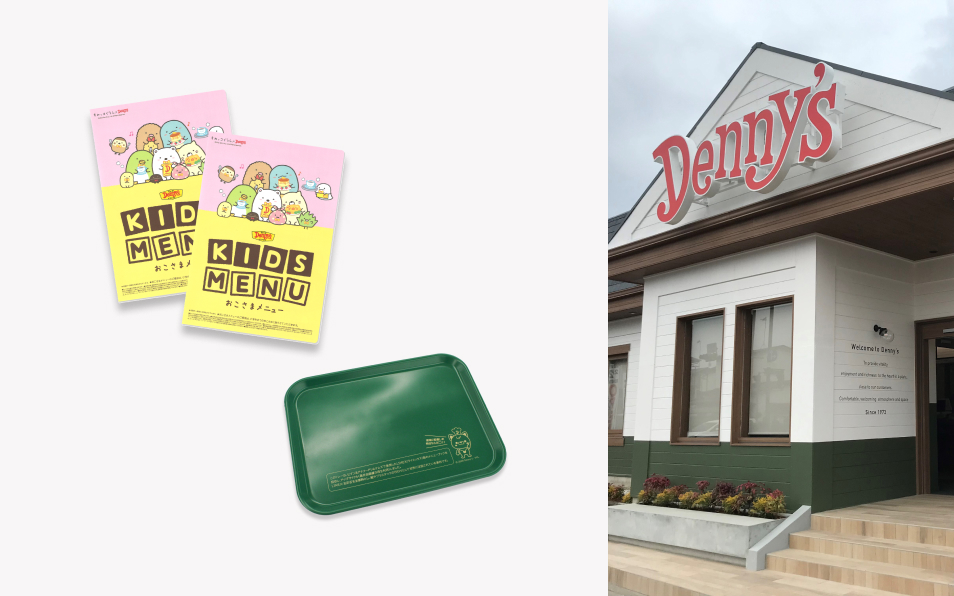

- Company name: Denny's (Seven & i Food Systems Co., Ltd.)
- Industry: Food and Beverage
- Menus and POP displays for various uses
- URLSeven & i Food Systems' CSR REPORT
table of contents
- Challenges, adopted products, and effects
- Based on numerical targets, we are currently implementing specific measures.
- With LIMEX, you can recycle and continue using it even after use.
- Evaluate supply volume, price, durability, and remanufacturing capabilities.
- Visualizing efforts in environments that are difficult to explain.
- A system for remanufacturing that changed the perception of poster replacement.
- An unexpected benefit: significantly reducing lamination costs.
- Industry first: Achieving mechanical recycling of LIMEX.
- LIMEX's strength lies in its ability to "continue to be regenerated."
- 【assignment】
- Specific initiatives to achieve numerical targets for the group's environmental commitment, "GREEN CHALLENGE 2050"
- [Products that were selected]
- Table menu
- Recycled trays (remanufactured through mechanical recycling)
- Business card
- Poster
- 【effect】
- Denny's has remanufactured LIMEX children's menu trays, collected and used at all 316 of its restaurants, into recycled trays, achieving the industry's first LIMEX mechanical recycling.
- Contributing to the realization of key priorities of "GREEN CHALLENGE 2050," such as "reducing CO₂ emissions" and "addressing plastic waste."
- By introducing posters, we can reduce the cost and effort of lamination.
* mechanical recycling is a recycling method that involves collecting used materials such as plastics, metals, glass, and paper, and then processing and reusing them as raw materials. Approximately 8 million tons of plastic are discarded annually in Japan, but when including simple incineration and thermal recycling (energy recovery), about 70% of it is incinerated. The domestic mechanical recycling rate remains low.
Click here for details
Seven & i Food Systems is a company that handles all aspects of the food business, primarily through its restaurant business, including the family restaurant "Denny's," and its contract food business. The group as a whole positions sustainability as a key pillar of its management and promotes diverse measures tailored to the characteristics of each business.
This time, we spoke with Mr. Nakagami, the head of the Environmental Department in the General Affairs Division of Seven & i Food Systems, about the background and effects of introducing LIMEX products.
Nakagami's Profile
General Affairs Department, Sustainability Promotion/Environment Committee Chairperson, Environmental Counselor (Registered with the Ministry of the Environment)
Chairperson of the cross-departmental "Environment Committee." Composed of members from multiple departments, including Human Resources and Store Management, the committee is responsible for promoting environmental policies across the entire group and within the company. Primarily involved in coordinating with and leading various departments, as well as planning policies.
Based on numerical targets, we are currently implementing specific measures.
- Please tell us about your company's/group's mission and vision regarding the environment.
- Mr. Nakagami
The entire group has adopted an environmental commitment called "GREEN CHALLENGE 2050," based on four key areas: CO₂ emission reduction, plastic waste reduction, food loss and waste reduction, and sustainable procurement. We have set interim targets for 2030 and numerical targets for the ideal state of the group by 2050, and are implementing specific measures tailored to the characteristics of each business (such as Seven-Eleven and the restaurant business).
While we feel a sense of obligation to address climate change as a corporate responsibility, we also believe that taking this seriously is an important factor in ultimately increasing corporate value.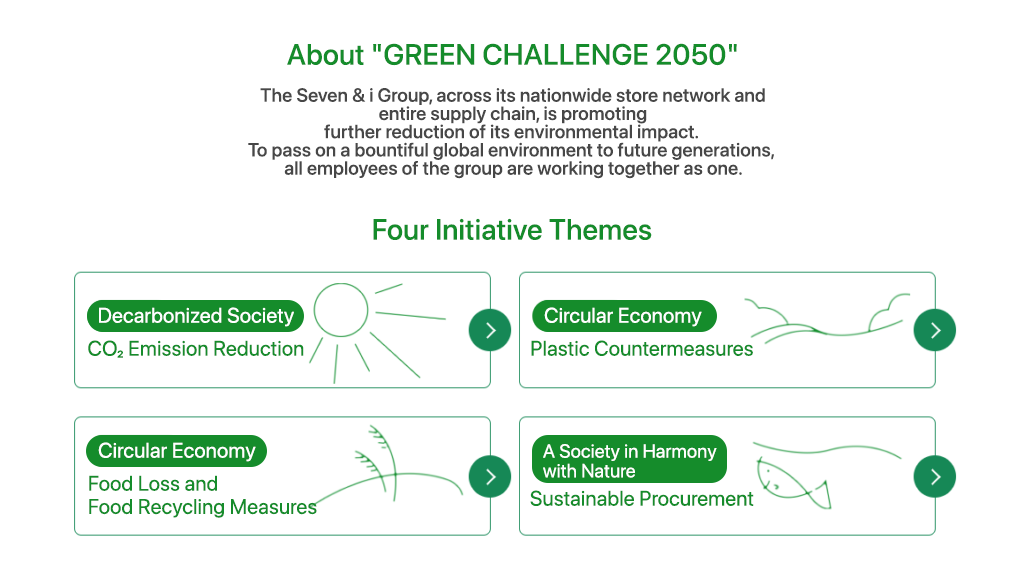
GREEN CHALLENGE 2050 | Sustainability: https://www.7andi.com/sustainability/g_challenge/
With LIMEX, you can recycle and continue using it even after use.
- How did you first learn about LIMEX? What aspects of it appealed to you?
- Mr. Nakagami
It all started when we received a proposal for container packaging materials, such as cake boxes. Later, we were also offered business cards, and we were very attracted to the fact that they could be manufactured with low energy consumption and that the product could be held in people's hands, making the effort visible. In particular, we thought that the possibility of mechanical recycling used materials would be a great advantage in reducing waste and realizing a circular economy.
- What were the key factors in deciding to implement LIMEX?
- Mr. Nakagami
The fact that it can be recycled after use was a major factor in its adoption. To expand the possibilities of mechanical recycling, we considered using it in other products such as drink bar trays and cafe menus, and internally, discussions progressed towards building a system based on "collection and recycling," which was not possible with existing environmentally friendly materials. Ultimately, we decided to introduce it for business cards, which are items used by all employees, in-store posters for employees and partners, and children's menus used in Denny's restaurants.
Evaluate supply volume, price, durability, and remanufacturing capabilities.
- I understand that you also conducted comparative studies with other environmentally friendly materials.
- Mr. Nakagami
Yes, we considered other environmentally friendly materials such as bamboo straws and bagasse (sugarcane pulp). However, we couldn't find a satisfactory solution in terms of supply, price, and durability. Regarding LIMEX, in addition to the points mentioned above, we highly valued its unique feature of being able to be collected and recycled, and decided to adopt it.
Visualizing efforts in environments that are difficult to explain.
- Could you tell me about the internal approval process before the decision to implement the system was made?
- Mr. Nakagami
Within our company, as part of our environmental committee's efforts, we created a proposal document for implementation that included specific numerical targets based on LCA (Life Cycle Assessment)*. During this process, we received support from your sales representative, primarily in preparing answers to anticipated questions and concerns, and ultimately obtained approval from the management committee.
*Life Cycle Assessment (LCA): A method for scientifically and quantitatively evaluating the environmental impact of a product or service throughout its entire lifecycle or at specific stages of that lifecycle.
- How was the initiative publicized?
- Mr. Nakagami
By incorporating LIMEX promotional materials into business cards, menus, posters, and other materials, we were able to visually communicate our environmental initiatives.
A system for remanufacturing that changed the perception of poster replacement.
- Please tell me about the effects after implementation.
- Mr. Nakagami
Previously, each store replaced posters four times a year, but some stores, with good intentions, continued to display old posters. As a result, the same design remained on display for too long, reducing visibility and rendering the content updates ineffective. However, with LIMEX, we were able to communicate within the company that we would collect and remake the posters, which motivated us to replace them.
An unexpected benefit: significantly reducing lamination costs.
- LIMEX allows you to easily create posters with a multifunction printer. Please let me know if it is effective in terms of reducing costs and labor.
- Mr. Nakagami
Previously, posters required the extra effort and cost of laminating printed paper. However, with LIMEX, we can print them using our group's multifunction printers and stick them directly onto the wall, making them easy to use. We also appreciate their high durability and water resistance, making them very convenient. Furthermore, introducing LIMEX made us realize the enormous amount of lamination we were using annually. Lamination made from paper and plastic is difficult to recycle and often ends up being thrown away, so we appreciate the benefits of LIMEX, which is recyclable.
Industry first: Achieving mechanical recycling of LIMEX.
- Your company's mechanical recycling initiative is the first of its kind in the industry. What process did you use to achieve this?
- Mr. Nakagami
During the consideration phase for remanufacturing, we had your sales representative visit our store, and we held discussions on-site. Ultimately, we collected LIMEX menu boards and remanufactured them into trays. These trays were then introduced to all Denny's locations as trays for the drink bar. The remanufactured recycled trays are just as durable as the original trays. Furthermore, we carried out a second remanufacturing in 2023. Similar to the first time, we remanufactured menu boards into trays, contributing to a reduction of approximately 45% in the use of petroleum-based plastics and a reduction of approximately 29% in greenhouse gas emissions, including CO2.
* Based on LCA (Calculation of Environmental Impact from Raw Material Procurement to Disposal) by TBM. May vary depending on manufacturing conditions. This is a reference value and not a guaranteed value.
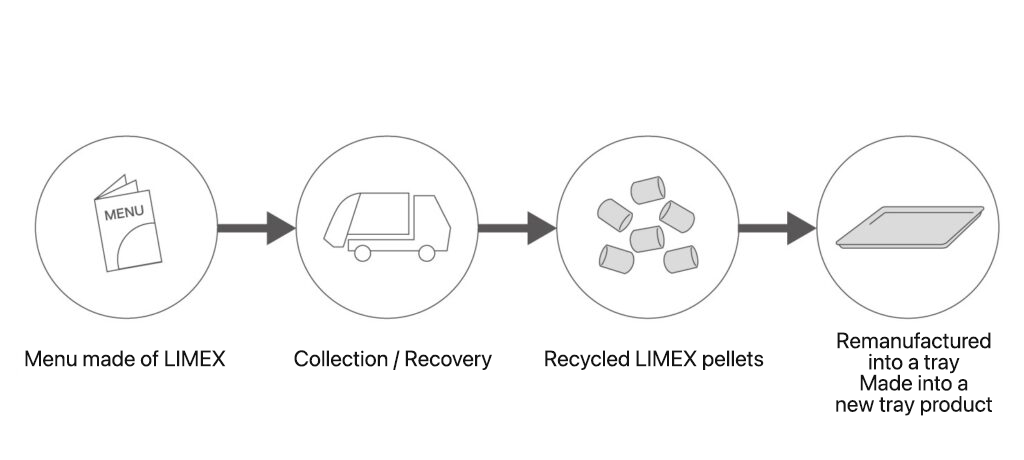
LIMEX's strength lies in its ability to "continue to be regenerated."
- What are your future plans for environmental initiatives, including LIMEX?
- Mr. Nakagami
Currently, its use is limited to business cards and a few products, but we are considering introducing it to a wider range of applications in the future. We believe that LIMEX's greatest strength is that it is "not disposable, but continuously recyclable." To further solidify this, we are also hoping for further improvements to the collection system.
Furthermore, I believe that strengthening cooperation with the national and local governments and working to revise legal regulations such as the Food Sanitation Act, which are obstacles to mechanical recycling, would greatly expand the possibilities for material circulation.
Seven & i Food Systems has adopted LIMEX menu boards and is promoting comprehensive initiatives toward realizing a sustainable society, such as collecting them after use and recycling them into trays. TBM will continue to actively support Seven & i Food Systems' efforts.